Transforming an In-Person Business into SaaS
How we pivoted a regional education business from in-person instructional programs into an EdTech SaaS operation.
The challenge
The business was originally built around live education.
Instruction was delivered through in-person programs, workshops, and events, with curriculum living in slide decks, shared folders, and instructor notes. While the model worked locally, it did not scale. Every new program required hands-on coordination, manual setup, and instructor availability. Consistency varied, and growth depended on adding people rather than improving systems.
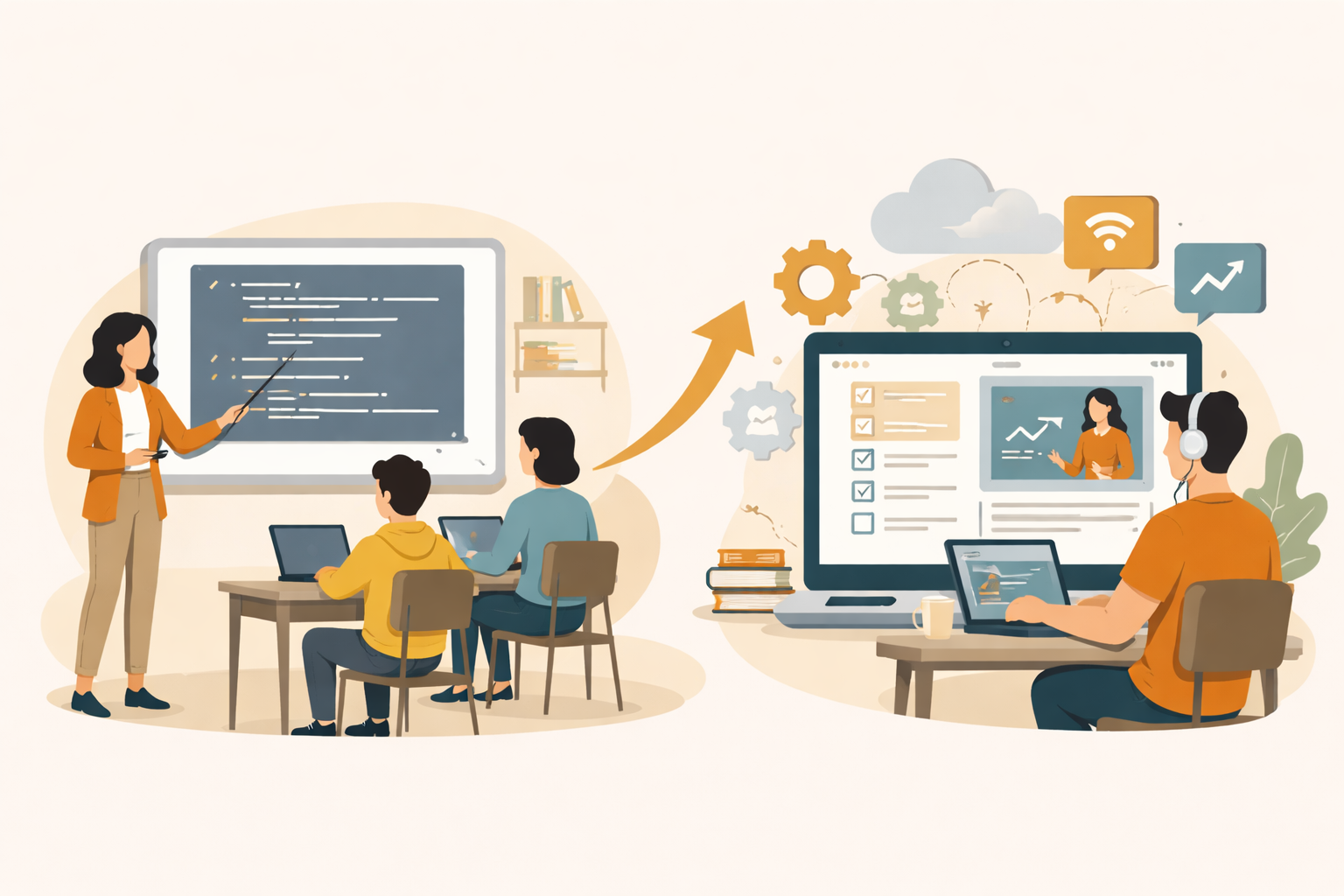
As demand increased and delivery formats expanded to include remote and hybrid instruction, the limitations of the model became clear. The business needed a way to deliver content on-demand and asynchronously, while still supporting live instruction for events, classrooms, and Zoom-based programs. Off-the-shelf tools could not support both needs without significant compromise.
The challenge was not simply moving classes online. It was redesigning the entire business model so education could be delivered through a single, scalable platform without breaking existing programs.
What we did
We treated the problem as a platform and operating model build, not a tooling decision.
First, we mapped how curriculum was created, delivered, updated, and taught across all existing formats - in-person, live remote, and asynchronous. This surfaced duplication, manual work, and gaps that made consistency difficult as the business grew.
From there, we supported the design and launch of a proprietary learning management system that could serve as the backbone of the business. The platform was built to deliver self-paced instruction on-demand, while also functioning as the central system for curriculum, lesson plans, and materials used in live classes and events.
We worked cross-functionally to define requirements, prioritize features, and coordinate development so the platform supported real operational needs, not just technical goals. Instructor workflows, content updates, student progress tracking, and program setup were standardized so delivery no longer depended on individual workarounds.
At the same time, we redesigned internal processes around the new platform. Teams were aligned on ownership, release expectations, and feedback loops so the LMS could evolve alongside the business without disrupting ongoing programs.
Impact
- Enabled a full business model shift from event-based education to a platform-led SaaS operation
- Launched proprietary LMS software supporting asynchronous learning and live instruction
- Reduced dependence on manual setup and instructor coordination across programs
- Improved consistency of curriculum and student experience across delivery formats
- Created a scalable foundation that supported national expansion and revenue growth
What happened next
With the platform in place, the business stopped being constrained by how instruction had always been delivered.
Students could learn on-demand without waiting for scheduled events. Instructors had a single system to prepare, teach, and track progress across both live and asynchronous programs. New markets could be supported without rebuilding delivery from scratch.
Most importantly, the company no longer operated like an events business trying to grow. It operated like a SaaS company with education at its core - able to scale, iterate, and improve without adding unnecessary complexity or headcount.
Dealing with something similar?
If growth has made your systems harder to manage instead of easier to run, we can help you bring clarity, structure, and momentum back into the work. Let's talk!